
Oconee County Criminal Docket Searches
The official Oconee docket page routes searches to Tyler Case Management Plus. Continue as a guest, then use Party Name when the number is unknown. The portal requires at least two letters and directs users to enter last name before first name without a suffix. Search every plausible spelling. Optional court, division, filing-date, and status filters can cut false matches, but a narrow filter can also hide the correct Oconee County criminal case.
Exact Case Number mode needs a four-digit year and a sequence of up to six digits. Tyler pads the sequence to six digits. A safe format is SU-CR-YYYY-NNNNNN, not a made-up real case. When the portal fails, call the Clerk of Superior, Magistrate & Juvenile Courts at 706-769-3940 or visit the clerk counter in Room 208 at 23 North Main Street, Watkinsville.
- Open Tyler and choose guest access or an approved account.
- Select SU for Superior or MG for Magistrate.
- Search by party name or exact year and case sequence.
- Open the match and inspect its details and Proceedings tab.
- Ask the clerk or eCertification service for a certified record.
Oconee Criminal Division Codes
Oconee County criminal docket routing starts with two fields. Court Code identifies the venue, and Court Division narrows the kind of work. Superior Court uses SU. Its visible criminal choices include CR Criminal, CT Criminal Transfer, PT Pre-Trial Diversion, R Probation Revocation, DD Dead Docket, W Warrants Dismissed, and FV Family Violence. Magistrate Court uses MG, with criminal, prewarrant, felony warrant, misdemeanor warrant, misdemeanor citation, probation, commitment hearing, and search warrant divisions.
| Code | Oconee search use | Key limit |
|---|---|---|
| SU / CR | Superior criminal matters | Does not cover all lower courts |
| MG / CR | Magistrate criminal work | Warrants have added divisions |
| MU / OR | Municipal ordinance index | Not every city record is assured |
The portal labels are routing aids, not final legal findings. In particular, Dead Docket is a displayed division. Its legal effect depends on the actual order and case history. Confirm any unclear status with Angela Elder-Johnson’s clerk office.
Criminal Dockets: What They Show
The verified Tyler layer shows party names, court and division, filing-date filters, case status, and exact number components. The county’s 2024 user guide also documents result counts, case selection, Proceedings, Print Index, available images, and an image cart. No anonymous sample exposed a full Oconee County criminal disposition codebook, so a label must be checked against the filed order when precision matters.
| Case Number | Court, division, four-digit year, and six-digit sequence. |
|---|---|
| Filing Date | The date used by Tyler’s From and To search filter. |
| Status | Active, Inactive, or All; local meanings are not fully published. |
| Proceeding | A recorded case event or setting shown in the guide’s Proceedings view. |
| Image | A linked filing available only when access and account approval allow it. |
| Disposition | The outcome, which should be verified in the docket and controlling order. |
Oconee Proceedings and Images
The county-linked Tyler public-record home separates a searchable index from document images. A guest may locate a case but still lack image access. The official user guide says valid account holders approved by clerk staff can view available images, add copies to a cart, and print or save purchased items for 30 days. It also provides a Print Index function.
The distinction matters. Proceedings can identify the course of an Oconee County criminal case, while an image may contain the filed motion, order, or other document behind that line. Neither a screen result nor an index print is automatically a certified copy. The eCertification route or clerk supplies a record meant to carry certification.
Tyler’s Party Search screen illustrates the party, court, division, filing-date, and status controls used for the criminal docket.
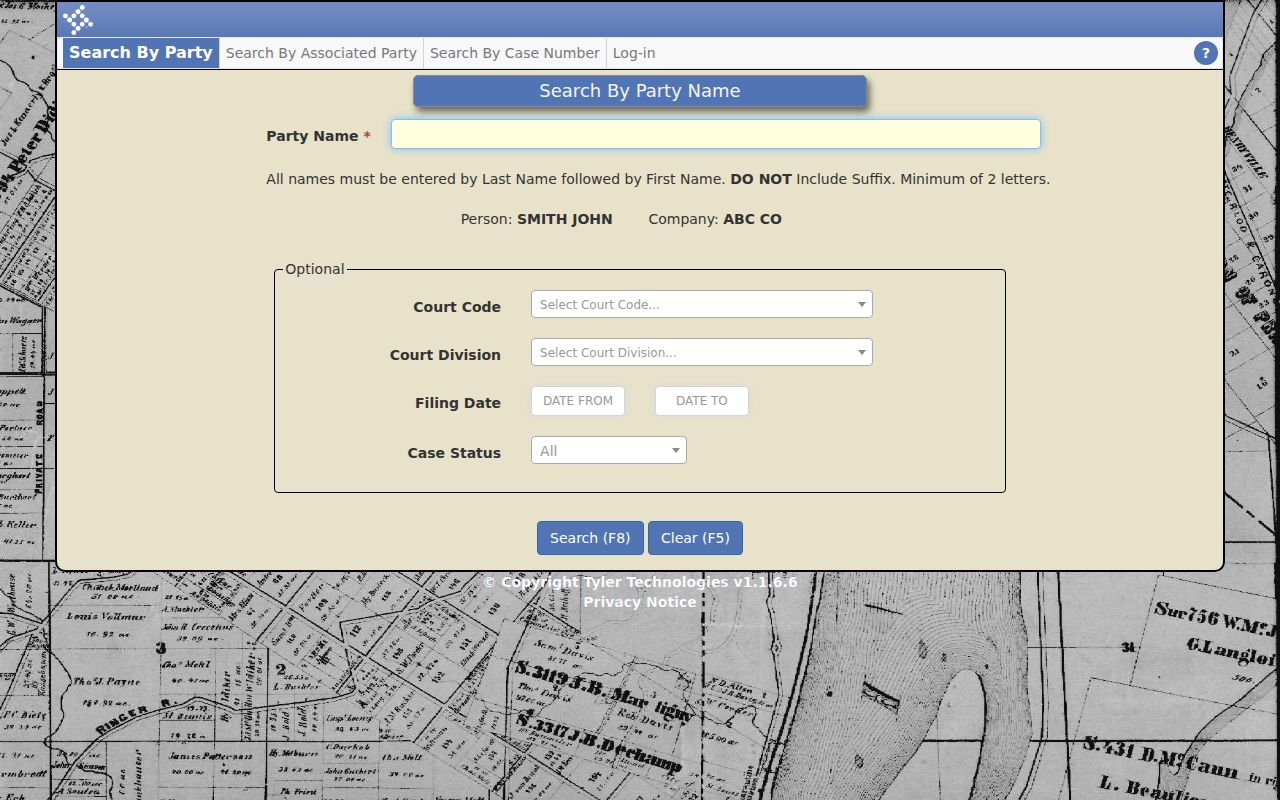
The captured interface reinforces why the court and division should be chosen before relying on a match. The image dimensions are preserved from the manifest capture.
Criminal Case Stages on the Docket
A criminal docket is an ordered record, not a promise that each case follows one fixed path. A filing may be followed by an arraignment, motions, pretrial settings, a plea or trial, disposition, and sentencing. Transfers, diversion, probation revocation, or warrant proceedings can create different sequences. The local Tyler divisions make those branches visible at the search level, though the actual Proceedings and orders control.
Docket flow: Filing › Arraignment › Pretrial › Plea or Trial › Disposition › Sentencing
Active and Inactive are search filters. They do not state why a matter moved, whether a charge was resolved, or what an order requires. Search both when tracking an older Oconee County criminal docket, then read the newest proceeding and filed order.
Oconee Criminal Filing Route
Oconee County says Superior and Magistrate criminal filings are accepted through PeachCourt. That is an electronic filing channel, not the public criminal docket. Lawyers and parties use the filing provider to submit material, while the public uses Tyler to search the index. A fresh filing can also take time to appear after submission and clerk processing.
The PeachCourt account screen shows the provider entry used for e-filed criminal material.

This source helps separate filing access from record access. A PeachCourt login does not replace the Oconee County criminal docket search or the clerk’s certified-copy service.
Oconee County Criminal Docket Courts
Oconee County has no separate State Court. Superior Court is the main felony venue. Magistrate Court handles warrants, preliminary criminal work, and the criminal divisions shown in Tyler. Probate Court keeps county traffic and the misdemeanor categories assigned to its office. Municipal courts keep city traffic and ordinance matters within their authority. Juvenile records follow separate confidentiality rules.
Venue should be confirmed from the summons, citation, case number, or clerk. A missing SU result does not prove that no matter exists. It may belong under MG, a municipal clerk, Probate Court, Juvenile Court, or the federal Athens Division. A county traffic citation also should not be forced into the Superior criminal search.
The Tyler disclaimer screen states the limits of the electronic public-record search.
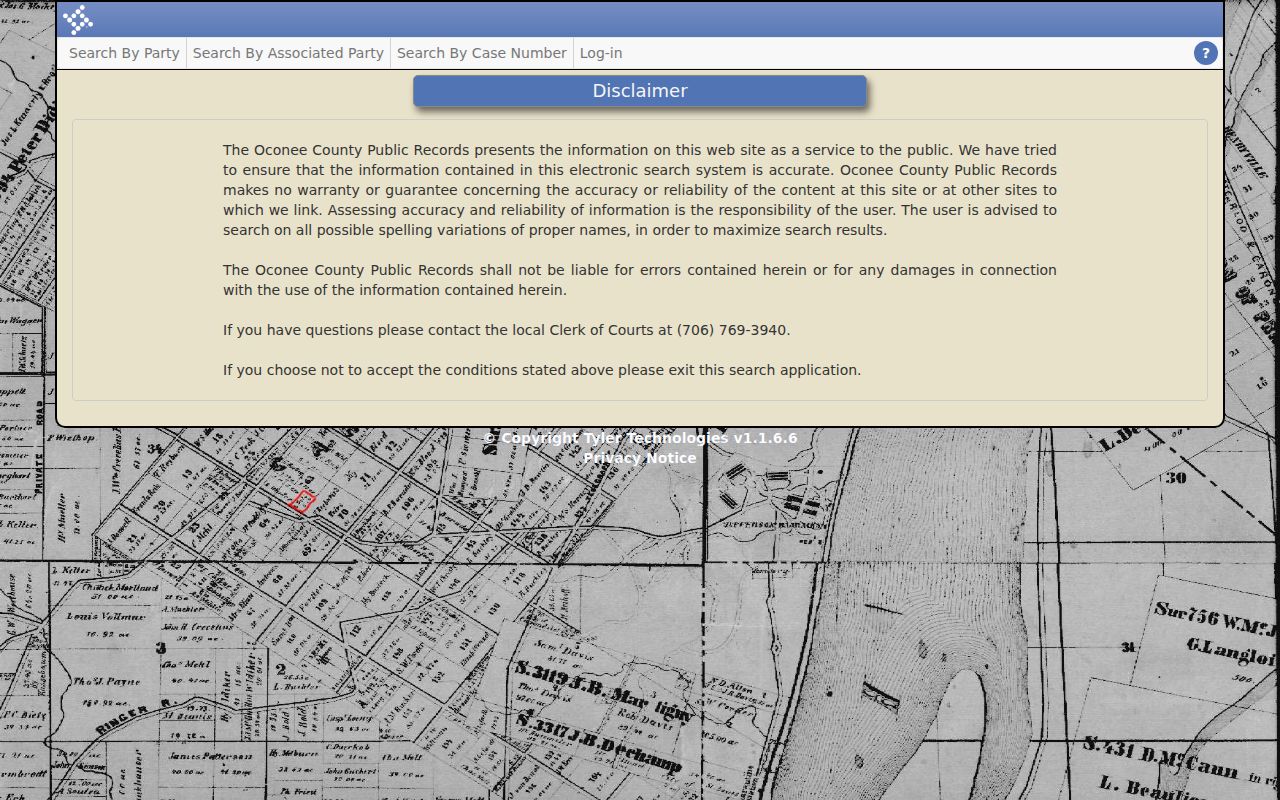
Its accuracy warning supports a simple rule: verify a criminal docket entry with the clerk and the original court record.
Missing Oconee Criminal Cases
Start with search mechanics when an Oconee County criminal docket does not appear. Try all name spellings, drop the suffix, widen the filing dates, confirm the court code, and test both Active and Inactive. Then check whether the case number was split into the correct year and six-digit sequence. Associated Party search may help when a person is connected to a case but is not listed as its main party.
If those checks fail, contact the responsible clerk. Recent filings may await processing. Images may require account approval. A Juvenile, sealed, redacted, municipal, Probate, or federal record may sit outside the expected public path. Absence from one search result is not proof that a case or proceeding never existed.
Note: The research found no public Oconee criminal-calendar export, local disposition-code sheet, or anonymous sample docket that resolves every status label.
Access Rules for Criminal Dockets
Uniform Superior Court Rule 21 starts with public access to court records, unless law or the rule’s process limits access. A court may restrict a record after weighing privacy harm against public interest. Protected identifiers may be redacted, and some images can remain unavailable even when an index line is visible. Juvenile information is subject to Georgia Juvenile Code confidentiality and is not an ordinary public Tyler record.
Key rules: Uniform Superior Court Rules 21 and 36.16 govern access limits and place electronically filed records under the same basic public-access rule as paper records.
The Georgia Open Records Act does not override a court sealing order or require an agency to create a new report that does not exist.
A criminal court docket is distinct from an arrest, jail, incident, body-camera, or 911 record. Those law-enforcement materials have different custodians. For a charge, setting, court filing, or disposition, use the clerk and the court record.
The Georgia Supreme Court rules index provides the current rules and amendment record.
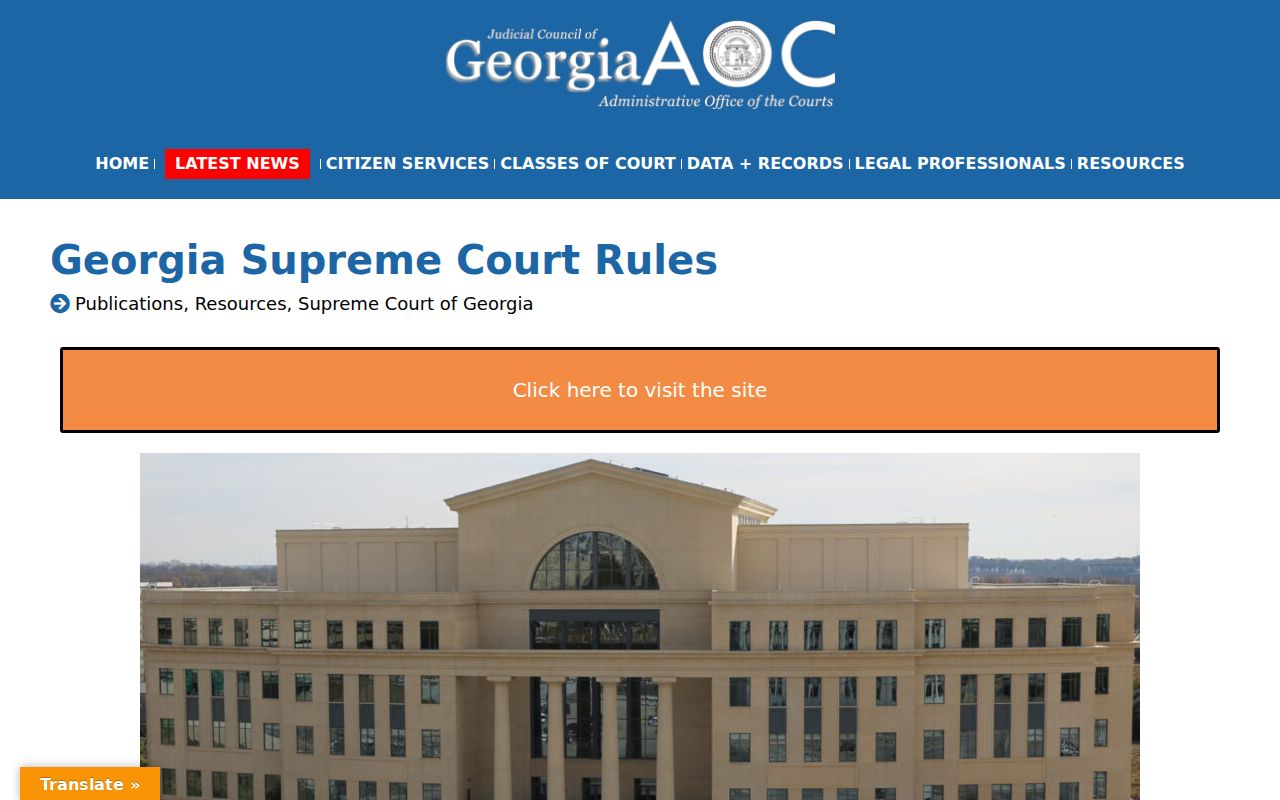
The rules source supplies the access framework, while the Oconee clerk decides how a specific public copy can be delivered.